Fendt 2026. At the end of August, Fendt unveiled the technological and product upgrades that will characterize its upcoming tractor lines. Significant evolutions are planned across all series in terms of power, transmission, comfort, and safety

Instead of waiting until November and the German trade fair Agritechnica to showcase its new tractor developments, Fendt chose to move ahead by presenting, at the end of August, the range expansions and upgrades that will define its 2026 models.
The list of innovations is extensive—both in terms of new products and performance enhancements—and involves all non-specialized series, from the 300 up to the 1000, including the 500, 700, and 800 series, all of which naturally feature Vario transmissions.
In summary, the 300 Series reaches its fifth generation, now expanding downward with the new 310 Vario DP, delivering 103 horsepower that rise to 113 thanks to the DynamicPerformance system.
This feature increases output by about 10 horsepower to compensate for the tractor’s internal power demands, keeping most of the rated power available for the implements.
This system is also adopted in the higher series, adding an extra 10, 20, or 23 horsepower in the 500, 700, and 800 models, and 26, 27, or 30 horsepower—depending on the version—for the 1000 Series.

Regardless of the range, all tractors are now equipped with AGCO Power engines—four- or six-cylinder units from the Core 50, Core 75, and Core 80 families—representing one of the most striking innovations in Fendt’s 2026 lineup.
The four-cylinder Core 50 engines power the fourth-generation 500 Vario models, ranging from 134 HP on the 513 Vario up to 164 HP on the top-of-the-range 516 Vario.
The six-cylinder Core 75 units distinguish the “7.1” generation of the 700 Vario, now offering DynamicPerformance across the entire series, with maximum outputs ranging from 223 to 283 HP.
This top performance level serves as the entry point for the fifth-generation 800 Vario, powered by Core 80 engines, delivering maximum outputs of 313 and 343 HP depending on the model. The new 800 Vario also features the VarioDrive traction system, which dynamically and independently manages power distribution between the front and rear axles—minimizing slippage and ground impact during turns.

Finally, the fourth-generation 1000 Series extends the upper power range with the introduction of the new 1052, equipped with a MAN engine. Its maximum output reaches 580 HP in DynamicPerformance mode, though it can be reduced if lower power is required by aligning with the settings of smaller models.
Beyond performance, all series now benefit from significant improvements in comfort, functionality, and reduced maintenance costs—upgrades that will be detailed further in dedicated presentations.
The engines are AGCO Power Core 50 units (Stage V compliant), with a displacement of five liters and approved for use with biofuels. Moving to the six-cylinder segment, the evolution continues with the 700 Series, which transitions to generation 7.1. The DynamicPerformance system—previously reserved for the flagship 728—is now extended to all four other models (720, 722, 724, and 726), covering a maximum power range from 203 to 263 HP, rising to 223–283 HP when needed.
The AGCO Power Core 75 engines are also Stage V compliant. Likewise, the fifth-generation 800 Series features three models (826, 829, and 832), offering maximum outputs of 260, 290, and 320 HP, which can increase to 283, 313, and 343 HP, respectively, with DynamicPerformance.
These models use six-cylinder AGCO Power Core 80 engines (8-liter displacement, Stage V). These series introduces the VarioDrive technology for the first time. And Fendt’s latest-generation Vario transmission—capable of dynamically managing power between front and rear axles to minimize slip and soil compaction during turns.
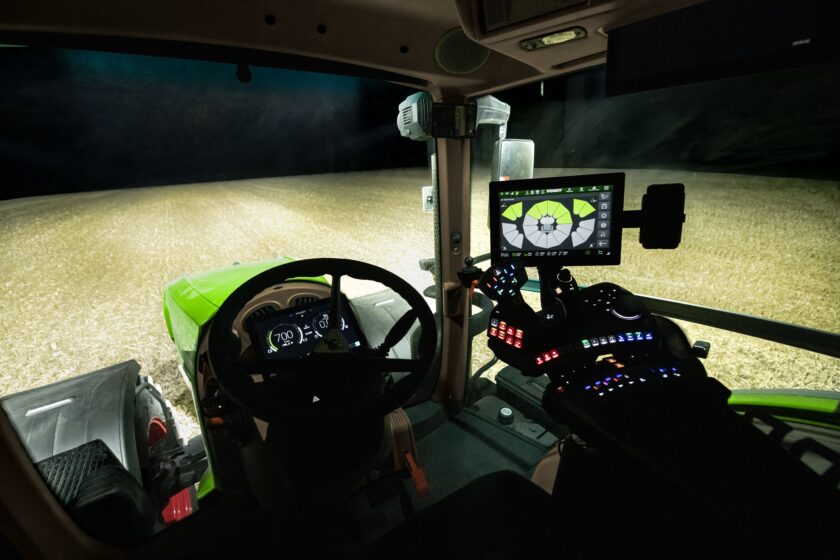
The new 800 Series also stands out for its self-cleaning engine air filter and a new cab equipped with a fully LED lighting system capable of producing up to 114,700 lumens.
The new generation also features improved cabs, offering enhanced visibility, better sound insulation, and upgraded air filtration. For those requiring extra traction, a twin-wheel hub option is available. Maintenance costs have been reduced as well—the transmission oil change interval has doubled, increasing from 2,000 to 4,000 operating hours.
Title: Fendt 2026: the new lineup preview
Translation with ChatGPT